
Every time you load a web page, your browser downloads more than what you asked for. In parallel, a series of requests go out to ad networks, tracking systems, and profiling infrastructure that you didn’t choose and likely don’t even know you’re financing with your bandwidth. In 2025, according to AdGuard’s annual report, these requests have crossed the 10% threshold of global internet traffic for the first time, hitting 10.22%. The previous year it was at 7.84%.
The raw number tells part of the story, but what’s striking is the estimate for hidden requests: every blocked primary request prevents roughly four additional ones, generated in cascade by connected servers. If nothing were blocked at all, according to AdGuard, trackers could cover up to 40% of total traffic.
The geographic breakdown
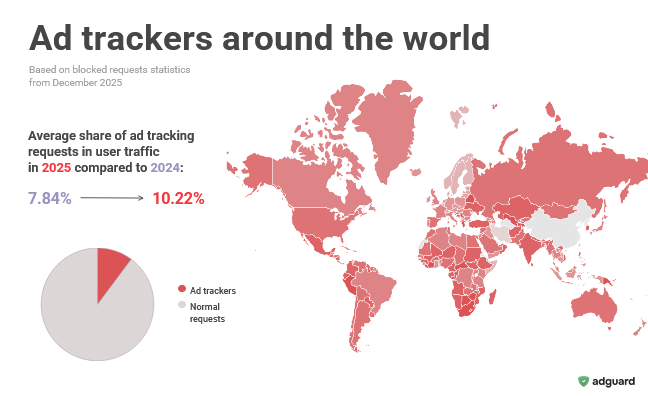
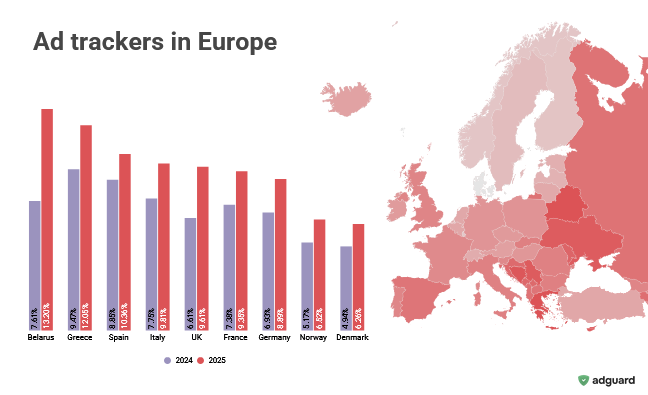
Growth isn’t uniform. The sharpest increases are in sub-Saharan Africa, the Caribbean, and Eastern Europe, where ad infrastructure expansion follows internet access expansion. South Africa jumped from 7.80% to 13.69%, Trinidad and Tobago from 6.33% to 12.94%. Belarus reached 13.20%.
Western Europe is growing more slowly but still growing. Spain hit 10.36%, France 9.35%, the UK 9.61%. Italy reached 9.81%, up from 7.75% in 2024. Germany remains below the European average at 8.89%.
At the bottom of the global ranking is China at 3.63%, along with Iran and some Northern European countries like Denmark and Norway. The complete country-by-country breakdown is available in the interactive map published by AdGuard.
More tracking, fewer banners
AdGuard highlights an apparent contradiction: the visible advertising experience is less intrusive than it was a few years ago, with the big, invasive banners now in retreat. But this doesn’t mean less advertising, it means quieter advertising. More bandwidth consumed in the background, more data collected, less visibility to the user.
 Mastodon
 Telegram
 Bluesky
 RSS
RSS