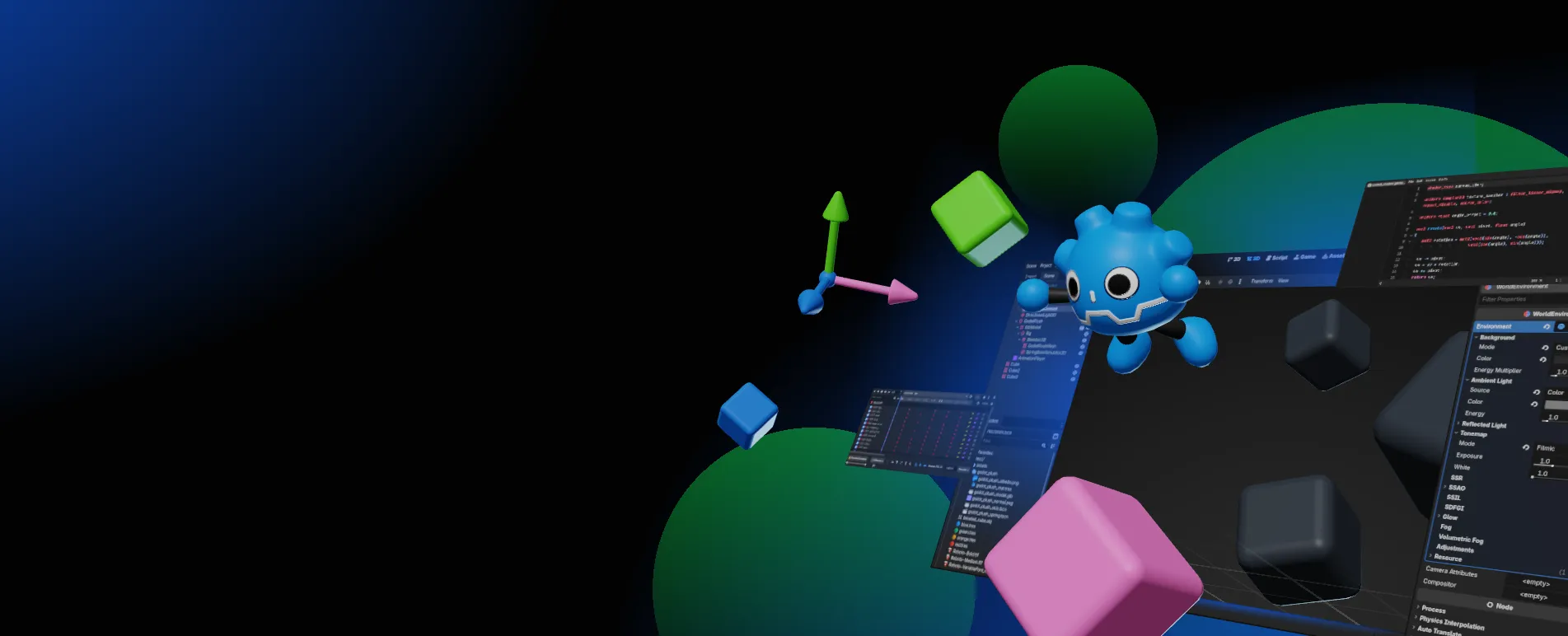
HDR support has been a notable gap in Godot’s rendering engine, but version 4.7 finally closes it. The first beta landed recently, and now Windows, Linux, and BSD users can enable HDR without special compiler tweaks, provided they have compatible hardware and displays. On Linux, it works through Wayland. The release also includes a ray tracing pipeline refactor and support for rectangular light sources in 3D space, which comes in handy for simulating windows or luminous screens in scenes.
Editor: Quality-of-life wins
The editor receives several long-awaited improvements. Vertex snapping lets you attach level elements to nearby object vertices by holding B and dragging, useful for building geometry that fits together without visual gaps. You can now snap Path3D curves to scene colliders, so you can trace paths that follow level geometry instead of placing waypoints randomly in space.
Another addition is copy-pasting entire property blocks from the inspector, rather than copying field by field. Animation tracks can now be grouped and collapsed, a simple but significant time-saver when working with complex animation trees.
GDExtension and animations
GDExtension, Godot’s system for extending the engine with native code (C++, Rust, and others), gets some useful refinements. The extension manager now lets you reload an extension directly without restarting the editor, saving real time during development cycles. A new Variant::get_type_by_name API is also exposed. Note that Object::ConnectFlags changes from enum to bitfield, a breaking change for existing GDExtension-based code.
For animations, the standout addition is AwaitTweener: tweeners can now wait for a signal to fire before executing the next action, eliminating the need for nested callbacks in conditional sequences. This pull request sat open for nearly three years.
Platforms and compatibility changes
Android gains native picture-in-picture support and vertical mode in the script editor, helpful when using the virtual keyboard. Wayland receives touch support.
Some changes break compatibility with existing projects, particularly around Jolt Physics (SoftBody3D), particles, and BlendSpace parameters. Full details are in the GitHub repository’s changelog. The beta is available from the official page in standard, .NET (with C# support), and online web editor versions.
 Mastodon
 Telegram
 Bluesky
 RSS
RSS