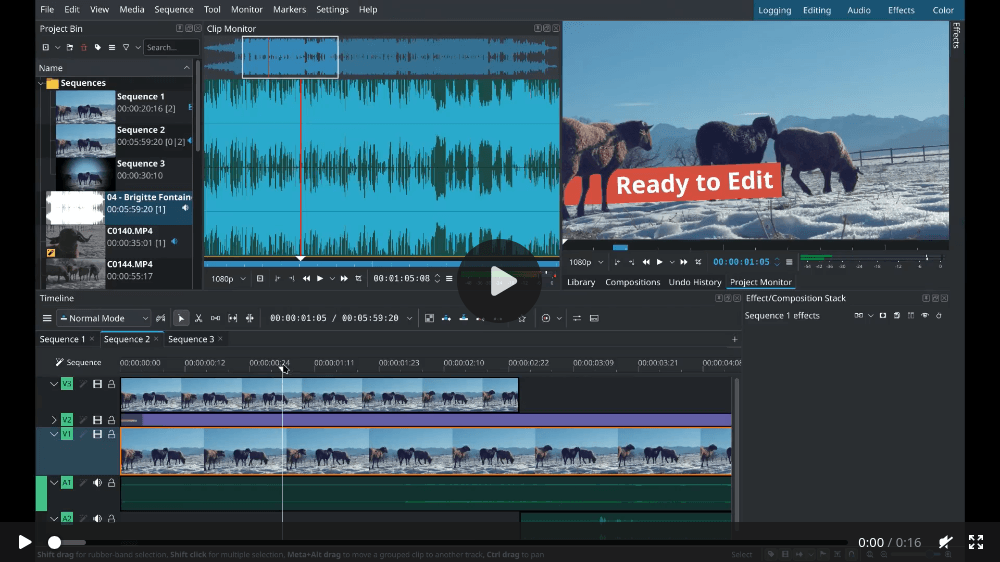
Kdenlive, the free video editor developed within the KDE project, recorded over 11.5 million downloads from its official site in 2025 alone. The annual report, signed by Farid Abdelnour, also notes 38 developers contributing code, with nearly half making their first career contribution. The project appears to be growing at a measured pace, prioritizing stability over feature accumulation, an approach longtime users particularly appreciate.
The three releases published during the year reflect this philosophy. Version 25.04, released in April, introduced the most visible new feature: an automatic masking tool that leverages SAM2, a Meta-developed object recognition model, to isolate elements from footage for removal or separate treatment. All processing happens locally, with no data sent to external servers. The same version also rewrote support for OpenTimelineIO, an open format that lets you transfer projects between different editing programs, such as from Kdenlive to DaVinci Resolve or Premiere and back.
A Year of Refinement
Version 25.08, released in August, focused almost entirely on bug fixes and overhauling the audio mixer, making it more readable and functional on high-pixel-density screens. Version 25.12, released before the holidays, revised the interface instead: a welcome screen for first-time users, a reorganizable panel system, and a preview monitor that now shows a minimap for navigating longer projects.
Donations Down, Sustainability Under Pressure
The most uncomfortable part of the report concerns funding. In 2025, donations totaled 9,344.80 euros, down roughly 20 percent from 11,526.61 euros the previous year. Against over 11 million downloads, the math is brutal. The team itself points out that if one in four people who downloaded it donated five euros, the project would have vastly different resources. Currently, these donations allow Jean-Baptiste Mardelle, the lead maintainer, to dedicate a handful of paid days per month to Kdenlive on top of his volunteer work.
Twenty percent of the budget goes to KDE e.V., the nonprofit organization managing KDE project infrastructure, to cover server costs, administrative expenses, legal support, and team travel.
The 2026 Roadmap
Coming in the months ahead is support for 10 and 12-bit color depth, allowing much finer gradations than traditional 8-bit color and handling color correction in post-production far better. Until now, this has been almost exclusive to commercial suites like DaVinci Resolve. Kdenlive should also gain OpenFX support, an open standard for video effects plugins adopted by Resolve, Nuke, and Fusion, making effects developed for other programs reusable in Kdenlive.
GPU-accelerated decoding is coming to lighten processor load and make video playback smoother during editing. Later, the Dopesheet will arrive, a panel dedicated to managing keyframes, the key points that define how an effect evolves over time, similar to what already exists in Blender or After Effects. This work is funded by a European grant through NLnet’s NGI Zero Commons program.
One final piece concerns Windows distribution. The team is working to make the program compatible with Microsoft’s compiler, a necessary step to publish it directly in the Microsoft Store and reach users less inclined to seek software outside official channels.
The next version, 26.04, is already in testing and will introduce monitor mirroring and animated previews for transitions.
 Mastodon
 Telegram
 Bluesky
 RSS
RSS