Canva unveiled AI 2.0 on April 16 at Los Angeles’ Create 2026 event, with the official announcement calling it “the most significant shift since our founding in 2013.” Strip away the marketing language and what emerges is a fairly precise project: turning Canva into a platform that lives inside your work tools, reads them, and produces content on its own.
What it actually does
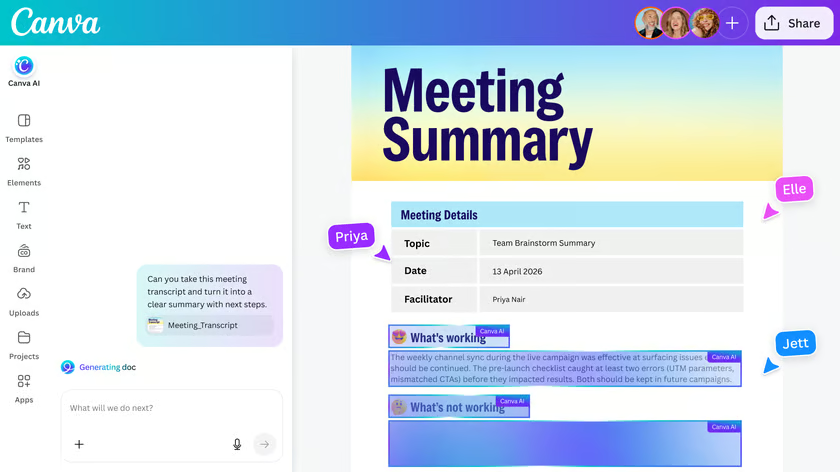
The core of AI 2.0 is an agentic conversational interface: you describe what you want, the system picks the tools, generates the design, and manages the workflow. Canva claims its proprietary models (Proteus, Lucid Origin, and I2V for images and video) are significantly faster and cheaper than comparable frontier models, at least by its own measurements.
Nothing groundbreaking so far. What changes is the connector list: Slack, Gmail, Google Drive, Google Calendar, Notion, and Zoom. The system can read meeting transcripts, extract information from client emails, and monitor Slack activity. It can also schedule recurring tasks on its own, like generating a batch of social content every Friday or preparing a morning briefing based on the day’s calendar.
Memory that “learns from you”
One of the most emphasized features is persistent memory: AI 2.0 learns from previous sessions, builds a personalized library based on designs already created, and develops a user profile that, according to Canva, “continuously personalizes the experience.” In practice, this means the platform collects and stores information about how you work, what you produce, and through those connectors, what you write and receive.
You don’t need to be particularly privacy-conscious to wonder what happens to this data, who accesses it, and how long it’s kept. Canva doesn’t say explicitly in its launch materials.
Five acquisitions in one quarter
Context helps here. In the first quarter of 2026, Canva acquired five companies, including Simtheory (multi-model orchestration specialists) and Ortto (marketing automation). AI 2.0 isn’t an isolated update: it’s the assembly of infrastructure designed to cover the entire content production cycle, from generation to publishing, all within a single ecosystem.
With 265 million monthly active users and annual revenue exceeding four billion dollars, Canva has the scale to pull it off. The real question is whether people using the platform are willing to give it access to their email, calendar, and work chats in exchange for smoother automation.
AI 2.0 is available as a research preview for early users who sign up from the homepage, with access rolling out progressively in the coming weeks.
 Mastodon
 Telegram
 Bluesky
 RSS
RSS